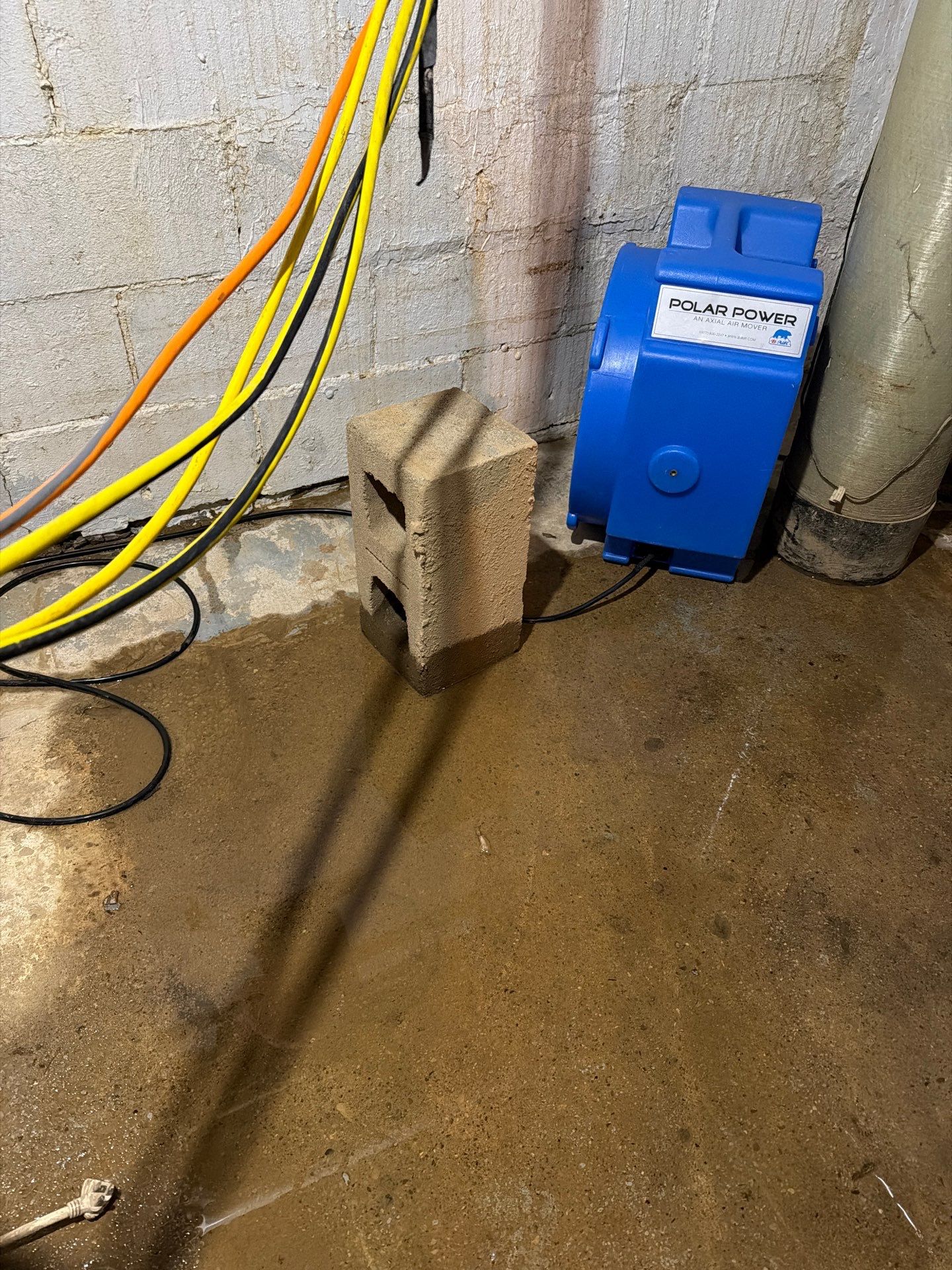
The Short Answer on Drying Time
Most water losses dry in 3 to 5 days with professional equipment. Some finish in 48 hours. Some take 10 days or more.
Here is what actually drives that range:
- Water category (clean, grey, or black)
- Class of loss (how much material is wet)
- Materials affected (carpet vs hardwood vs plaster)
- How fast extraction started
- Outdoor humidity and Danville weather
- Equipment count and placement
Professional Drying Timeline by Day
- Hour 0 to 24: Extraction and setup. Standing water removed with truck mounts and weighted extractors. Air movers and dehumidifiers placed. Moisture mapping with thermal cameras and pin meters. Baseline readings logged for your insurance file.
- Day 1 to 2: Aggressive evaporation. Air movers push moisture out of materials. Dehumidifiers pull 10 to 30 gallons of water per day out of the air. Daily moisture readings prove progress.
- Day 3 to 4: Deep material drying. Subfloor, wall cavities, and dense materials release the last of their moisture. Equipment may be repositioned. Some materials hit dry standard early and equipment is pulled off them.
- Day 4 to 5: Final verification. Readings match unaffected dry materials in the same home. Equipment removed. Drying log delivered to you and your adjuster.
- Day 6 and beyond: Repairs begin. Drywall, flooring, paint, and trim replacement. This is a separate phase from mitigation.
How to Tell Your Home is Actually Dry
You will know drying is complete when:
- Moisture readings match unaffected materials in the same home
- Relative humidity is back to normal indoor levels
- Surfaces feel and look dry at and below the surface
- No musty smell remains in affected rooms
- Daily drying log shows three stable readings in a row
- Wall cavities scanned with thermal imaging show no cold spots
- Subfloor pins read within 2 percent of unaffected reference points
Surface dry is not actually dry. A board can read 8 percent on top and 22 percent underneath. That is why professional readings matter before equipment leaves your home. Danville Water Restoration signs off only when the numbers prove it, not when the floor feels dry to a bare foot.
Equipment That Actually Dries a Home
The right gear, in the right quantity, is what separates a 4 day job from a 12 day job. Here is what we typically deploy:
- Air movers: 1 per 50 to 60 square feet of wet area, angled at 15 to 45 degrees
- LGR dehumidifiers: Sized to remove 10 to 30 gallons daily from Danville humidity loads
- Air scrubbers with HEPA filtration: For category 2 or 3 losses
- Injectidry systems: For wall cavities and hardwood without demo
- Heat drying: Speeds evaporation in stubborn materials
- Moisture meters and thermal cameras: Track progress with documented readings
- Desiccant dehumidifiers: For cold spaces and dense materials where LGRs slow down
- Containment barriers: Zip walls and poly sheeting that focus drying energy on wet areas only
Drying Time by Material
Not everything dries at the same speed. Here is what Danville Water Restoration sees on real Danville jobs:
- Carpet and pad: 24 to 72 hours with extraction. Pad often gets replaced because it dries slower than it rots.
- Drywall (surface wet): 2 to 4 days if caught early. Flood cuts may be needed at the bottom 12 to 24 inches.
- Hardwood flooring: 5 to 14 days with mat systems. Some boards cup and need refinishing.
- Subfloor (OSB or plywood): 3 to 7 days. Stays wet longer than what is above it.
- Concrete slab: 4 to 10 days. Holds moisture deep and releases it slowly.
- Plaster walls: 5 to 10 days. Older Danville homes near downtown often have this.
- Insulation: Usually removed. Wet fiberglass and cellulose almost never dry in place.
- Tile over wood subfloor: 7 to 14 days. Tile traps moisture below and slows evaporation dramatically.
- Engineered flooring: 5 to 10 days, but many planks delaminate and need replacement regardless.
What You Can Do While Equipment Runs
Drying works best when the home cooperates with the equipment. Help Danville Water Restoration hit the shorter end of the timeline by doing these things:
- Leave air movers and dehumidifiers running 24 hours a day, even at night
- Keep windows and exterior doors closed so dehumidifiers can do their job
- Set the thermostat between 70 and 80 degrees for fastest evaporation
- Do not move equipment around or unplug units to charge phones
- Keep pets and children away from cords and exposed tack strip
- Empty condensate buckets only if a tech asks you to
- Take daily photos for your own records alongside the official drying log
What Stretches the Timeline
If your job is taking longer than 5 days, one of these is usually the reason:
- Extraction started more than 48 hours after the loss
- Category 2 or 3 water (see our grey water cleanup guide for what category 2 means)
- Hidden moisture behind cabinets, under tile, or inside wall cavities
- High outdoor humidity in Danville summers
- Underpowered DIY equipment (one box fan does almost nothing)
- Building materials sealed under vinyl or laminate
- Sewage contamination that requires demo before drying
- Power limits in older homes that cap how many air movers can run on one circuit
- Multi-level losses where water traveled down through ceilings and into lower walls
Drying Time by Loss Type
Different losses have different baselines in Danville:
- Supply line break in a kitchen: 3 to 5 days
- Toilet supply leak overnight: 4 to 6 days
- Sewage backup: 5 to 8 days after demo
- Basement flooding from heavy rain: 4 to 7 days, longer if carpet stays
- Slow ceiling leak found late: 5 to 10 days due to hidden saturation
- Frozen pipe burst in January: 4 to 6 days, plus repair scope
- Dishwasher or fridge line drip: 5 to 9 days because the leak ran for weeks before discovery
- Water heater tank failure: 3 to 6 days, often with garage and adjacent room involvement
For burst pipe specifics, our burst pipe water damage guide walks through what to expect from extraction through repair.
Why Speed Matters in the First 24 Hours
Mold can begin growing within 24 to 48 hours on wet organic materials. Once mold starts, you are no longer just drying. You are remediating. That changes scope, cost, and your insurance claim.
Fast response also protects:
- Hardwood floors that cup permanently after 72 hours wet
- Drywall paper backing that delaminates and crumbles
- Cabinet bases and trim that swell beyond repair
- Subfloor adhesives that release under sustained moisture
- Electrical components that corrode silently
- Baseboards and door jambs that wick water upward into otherwise dry wall sections
- Personal contents like books, photos, and upholstery that pass the salvage window quickly
This is why Danville Water Restoration answers the phone overnight. If you need a faster picture of mitigation, our water mitigation services overview shows what the first 24 hours look like on a real job.